When I was growing up in a multi-faith household, “be a good person” sounded simple until it wasn’t. My Jewish relatives spoke about doing justice. A Christian neighbor talked about self-control. A Buddhist friend of the family kept saying, “Right action.” Different languages, similar longing: a sturdy inner character that can hold us steady when life gets complicated.
In the Catholic tradition, one of the most time-tested ways of naming that “sturdy inner character” is the cardinal virtues: prudence, justice, fortitude, and temperance. They are called “cardinal,” often explained from the Latin cardo, meaning “hinge,” because many other virtues swing on them. They do not replace grace or prayer. They describe the habits that make a human life more truthful, balanced, and reliably good.
What are the cardinal virtues?
The cardinal virtues are four “natural” or “human” virtues that can be cultivated through practice, education, and deliberate choice. In Catholic moral teaching, they are real virtues, not just personality traits. They are stable dispositions that help a person choose the good consistently.
- Prudence: wise discernment about what to do here and now
- Justice: giving each person what is due to them
- Fortitude: courage and endurance in difficulty
- Temperance: moderation and self-mastery in desires and pleasures
These four virtues also provide a practical vocabulary for everyday moral decisions. Not only “Is this allowed?” but “Will this make me more whole and more loving?”
Where did they come from?
Long before Christianity, Greek and Roman philosophers asked what makes a life good and what shapes a good citizen. Plato, especially in the Republic, is closely associated with a fourfold pattern of virtue. Aristotle did not canonize the same list as a fixed set, but his wider virtue ethics shaped how later thinkers understood moral habits, practical wisdom, and the formation of character. Later, Stoic thinkers emphasized self-command, courage, and justice as pillars of a stable life.
Christian theologians did not simply copy the philosophers, but they recognized something true in their moral insight. Over time, the Church integrated this classical “virtue ethics” into Christian teaching, especially through thinkers like St. Ambrose and St. Augustine, and most influentially St. Thomas Aquinas. The result is a moral vision where grace matters deeply, and where human habits matter too.
In Catholic language, the cardinal virtues are often described as virtues that perfect our natural powers: our reason, will, emotions, and desires. They form the moral “skeleton” that supports mature love.

Prudence
Definition
Prudence is the virtue of practical wisdom. It helps you discern the right thing to do, in the right way, at the right time. Prudence is not timidity. It is clear sight.
In the Catholic tradition, prudence is often described as the virtue that guides the others. Courage without prudence can become recklessness. Temperance without prudence can become rigid control. Justice without prudence can become harshness.
Plain examples
- In a difficult conversation: You tell the truth, but you choose a moment when the other person can actually hear it and you keep your tone respectful.
- Online: Before sharing a shocking headline, you pause, verify, and consider whether sharing will inform or inflame.
- At work: You notice a small ethical shortcut becoming normal and decide to address it early, before it becomes a crisis.
What prudence is not
- Not “being clever” at getting what you want
- Not avoiding risk at all costs
- Not constant overthinking disguised as discernment
Justice
Definition
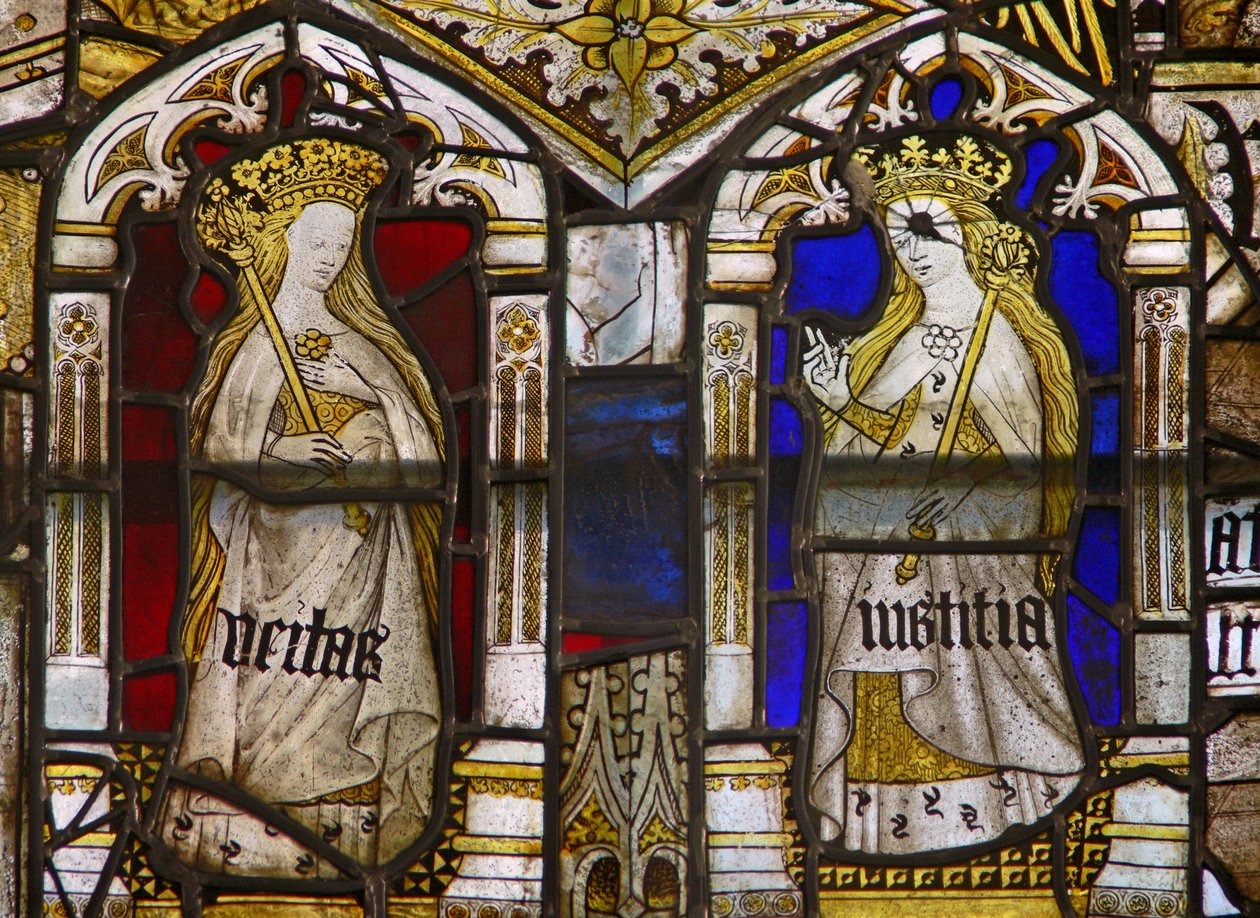
Justice is the steady will to give God and neighbor what is due to them. In everyday terms, it is fairness anchored in truth and responsibility, not in convenience.
If that line about “giving God what is due” sounds unusual, it helps to know that in classical Catholic accounts, honoring God is treated as a part of justice, sometimes named the virtue of religion. It is the idea that gratitude, worship, and truthfulness toward God are not optional add-ons. They belong to what it means to live in right relationship.
Catholic teaching also speaks about justice at multiple levels: personal (how I treat you), social (how systems treat people), and spiritual (how we honor God). This is why justice is not only a courtroom word. It belongs in families, workplaces, and communities.
Plain examples
- In relationships: You apologize without excuses when you wrong someone, and you make amends.
- In business: You pay a fair wage and do not profit from misleading advertising.
- In community: You take time to learn how local policies impact the vulnerable, and you support changes that protect human dignity.
What justice is not
- Not “getting even”
- Not reducing people to what they can produce
- Not a purity test where compassion disappears

Fortitude
Definition
Fortitude is the virtue that strengthens us to do the good despite fear, fatigue, or suffering. It includes courage in the moment and endurance over time.
I have seen fortitude most clearly not in dramatic heroics, but in ordinary perseverance: caregiving, recovery, remaining faithful to commitments, speaking up when silence would be easier. In Catholic moral teaching, fortitude steadies the heart so that love can remain active under pressure.
Plain examples
- At home: You set a boundary with someone you love because enabling them is harming them.
- In faith life: You keep praying through a dry season without forcing a fake enthusiasm.
- In integrity: You tell the truth about a mistake you made, even when it may cost you status.
What fortitude is not
- Not dominance or aggression
- Not denial of emotions
- Not stubbornness that refuses correction
Temperance
Definition
Temperance is the virtue of moderation. It orders our desires, especially around pleasure, consumption, and appetite, so that we are not ruled by them.
Temperance can sound like a scolding word until you realize what it protects. It protects freedom. When temperance is healthy, it is not a cramped life. It is spaciousness, the ability to enjoy good things without being owned by them.
Plain examples
- With food and drink: You enjoy celebration, and you also know when to stop because you want clarity tomorrow.
- With screens: You set a realistic limit, not because technology is evil, but because attention is sacred.
- With speech: You resist the quick pleasure of a cutting comment, and you choose words that are honest without being cruel.
- With shopping: You pause before buying and ask, “Is this need, comfort, boredom, or identity?”
What temperance is not
- Not hatred of the body
- Not perfectionism
- Not refusing joy

How they work together
In real life, our moral choices usually require more than one virtue at a time.
- Prudence helps you see what love requires in this specific situation.
- Justice keeps your choice aligned with truth, dignity, and what is owed.
- Fortitude gives you the backbone to follow through.
- Temperance keeps your impulses and appetites from hijacking the moment.
Imagine a simple scenario: a coworker takes credit for your work. Prudence helps you decide whether to address it privately first or involve a supervisor. Justice reminds you that truth matters and that you should not accept a pattern of deception. Fortitude helps you have the conversation without shrinking back. Temperance keeps anger from turning into cruelty or gossip.
Or take a family scenario: you need to tell a relative you cannot keep covering for their irresponsible choices. Prudence helps you choose the right time and words. Justice names what is fair to everyone affected. Fortitude gives you the strength to tolerate the discomfort. Temperance keeps you from unloading years of resentment in one speech.
Cardinal vs. theological
This is one of the most common points of confusion.
The cardinal virtues are “hinge” virtues that shape human character and can be developed through practice and moral education. In Catholic teaching, they are elevated and healed by grace, but they are still fundamentally about forming our human capacities.
The theological virtues are different. They are oriented directly toward God and are considered gifts infused by God’s grace:
- Faith: believing in God and what God has revealed
- Hope: trusting God’s promises and longing for eternal life
- Charity (love): loving God above all things and loving neighbor for God’s sake
A simple way to say it is this: cardinal virtues train us to live well; theological virtues unite us to God. They belong together. When faith, hope, and charity are alive, prudence becomes more luminous, justice more merciful, fortitude more resilient, and temperance more joyful.
If you have heard Catholics talk about “acquired” versus “infused” virtues, this is the basic idea: we can build real virtues through repeated choices and training, but God can also give virtues in a deeper mode through grace. In healthy Christian life, it is not either-or. Grace does not cancel human effort, and human effort does not replace grace.
How they shape morals
Catholic morality is often described only in terms of rules, but at its best it is also deeply about formation. Virtue language answers a quieter question beneath the headlines: Who am I becoming?
Virtues also help explain why two outwardly similar actions can have different moral weight. Not only what you did, but what you knew, what you intended, and whether you acted freely. Virtue offers a hopeful arc too: habits can change. Character can mature. A person can grow.
That is where conscience formation becomes more than a slogan. Conscience is not just a gut feeling. It is a judgment that needs light. For many Catholics, that formation happens through practices like an honest examen, learning the moral tradition, seeking wise counsel, and bringing real questions into prayer or spiritual direction.
Daily practice
If you want to work with the cardinal virtues without turning them into a self-improvement project, start small and concrete. Virtue grows through repeated, honest choices.
A weekly examen
- Prudence: Where did I pause and choose wisely? Where did I rush?
- Justice: Did I treat anyone as a means to an end? Did I repair what I harmed?
- Fortitude: Where did I act despite fear? Where did I need support but avoid asking?
- Temperance: What did I consume to soothe myself? What would actually restore me?
Even one truthful answer can become a doorway into deeper freedom.
Common questions
Are they only Catholic?
No. Their philosophical roots are older than Christianity, and many traditions value similar qualities. Catholic teaching adopts and deepens them within a God-centered view of the human person.
Why call them “natural” virtues?
“Natural” here means they correspond to human nature and can be acquired through practice. Catholic theology still teaches that grace heals and elevates our nature, but it does not erase it.
Do they guarantee I will not sin?
They do not remove freedom or temptation. But they make it easier to recognize the good and choose it consistently. Virtue is like strengthening a muscle: it does not eliminate effort, but it changes what you are capable of.
Which one matters most?
They work as a unity, but prudence has a special guiding role because it helps apply moral truth to particular situations. Still, a “prudent” life without justice or love would be a distorted prudence.