I first heard the Parable of the Prodigal Son at a kitchen table, not a lectern. I was a teenager, half listening while someone said, “It’s about forgiveness.” I nodded, as you do. But years later, after studying in communities where people had very different ideas of who counts as “worthy,” I realized how much of this story lives in the room around it. It is not only about a son who leaves. It is also about the people standing nearby who cannot stand the welcome he receives.
Luke places this parable inside a dispute. Jesus is eating with “tax collectors and sinners,” and the Pharisees and scribes are grumbling about it (Luke 15:1-2). In that atmosphere of complaint, Jesus tells three stories in a row: a lost sheep, a lost coin, and then this longer, aching family drama. To my ear, the Prodigal Son is Jesus’ most intimate picture of welcome. It is also one of his clearest pictures of resentment.
Retelling Luke 15:11-32
Jesus begins plainly: “There was a man who had two sons.” And almost immediately, the younger one asks for what he is not supposed to ask for. “Father, give me the share of the property that will belong to me.” In that world, inheritance is typically received after the father’s death. A father could choose to distribute assets early, but the request still lands with the chill of impatience, or worse, a kind of erasure. As if the son is saying, “I want your things, not you.”
The father divides his property anyway.
Not long after, the younger son gathers everything and leaves for a distant country. There, he squanders his wealth in reckless living. When famine hits, the money runs out and the hunger starts. He hires himself out and ends up feeding pigs, which in Jewish life are unclean animals. The detail is not accidental. Jesus is taking the picture all the way down. The son is so hungry he longs to eat what the pigs are eating, but no one gives him anything.
Then a turning: “He came to himself.” He remembers home. He remembers his father’s hired workers have bread, and he is starving. He rehearses a speech that is part confession and part survival plan: “Father, I have sinned against heaven and before you; I am no longer worthy to be called your son; treat me like one of your hired hands.”
So he goes back.
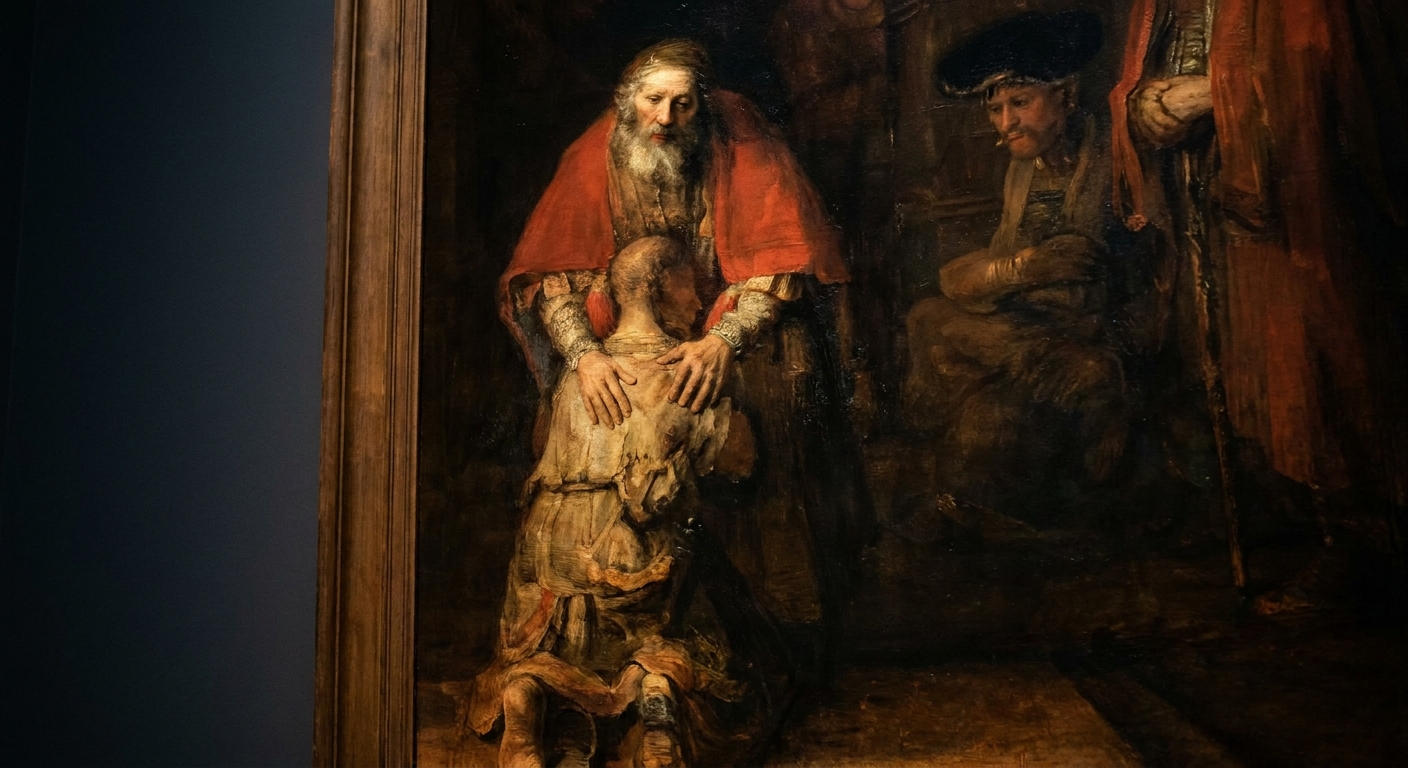
But while he is still far off, his father sees him. The father is moved with compassion, runs to him, embraces him, and kisses him. Before the son can negotiate his way into a lesser status, the father interrupts with commands to the household: bring the best robe, put a ring on his finger, sandals on his feet, and prepare the fatted calf. Make it a celebration. “For this son of mine was dead and is alive again; he was lost and is found.”
The party begins.
Then the camera angle shifts. The older son comes in from the field and hears music and dancing. He asks what is happening and learns the news: his brother is back, safe, and their father has killed the fatted calf.
The older brother’s response is not curiosity. It is refusal. He is angry and will not go in.
The father comes out and pleads with him. And the older son finally speaks what has apparently been building for a long time: he has served like a slave, never disobeyed, never got even a young goat to celebrate with friends. Yet this brother of his, who devoured the family’s property, gets a feast.
The father answers with tenderness and clarity: “Son, you are always with me, and all that is mine is yours. But we had to celebrate and rejoice, because this brother of yours was dead and has come to life; he was lost and has been found.”
And Jesus ends the story there, with the older brother still outside and the father still speaking.
Why Jesus tells this story
Luke is careful about the setting: religious leaders are upset that Jesus welcomes the wrong kind of people at the table. They are not complaining about his theology in the abstract. They are offended by his hospitality.
So Jesus tells a story in which the offense is not primarily the younger son’s rebellion, as shocking as it is. The offense, in the parable’s emotional center, is the father’s response. The father welcomes too quickly. Too publicly. Too generously. And he risks the anger of the “good” son in order to do it.
In other words, the parable is not a courtroom scene. It is a household scene. It is a table scene. Jesus is answering the question behind the grumbling: “What kind of God welcomes people like that?”
The father and welcome
The father is often treated as a symbol, and he is, but Jesus paints him with startling human specificity. He divides his property. He watches the horizon. He runs. He embraces. He orders clothing and food. He leaves his own party to go outside and plead with an angry son.
In many honor and shame readings of Jesus’ world, dignified patriarchs would have been expected to avoid running in public. Running is for servants or children. A grown man with status does not typically hike up his robe and sprint down the road if honor is the main concern. But compassion is the father’s main concern. He chooses the undignified action that closes the distance.
Notice also what the father does not do.
He does not demand an explanation before the embrace.
He does not make the son prove himself with a probation period.
He does not publicly shame him, even though others may well know the story.
The robe, ring, and sandals are not mere comforts. They are signals of belonging. The son does not come back as a hired worker. The father refuses that demotion. He restores him as “son” in front of everyone who might prefer a quieter, more cautious reintegration.
Sandals matter here, too. At minimum, they complete the picture of being received back into the household rather than managed at arm’s length. They say, in visible ways, “You are home.”
This is welcome with witnesses. Which is exactly what makes it so hard for the resentful heart to tolerate.

The younger son and coming home
The younger son’s arc is the most dramatic. He leaves with entitlement, spends with abandon, and returns with empty hands. Luke’s language is blunt: he “squandered” the property. Then he is reduced to feeding pigs, a vivid sign that he has crossed not only a moral line but a cultural one. He is far from home in every sense.
When he “comes to himself,” we can hear both desperation and honesty. Some readers worry his repentance is calculated. He rehearses a speech, after all. But when you are starving, clear thinking can sound like calculation. The parable does not ask us to psychoanalyze his motives. It shows us something simpler: the road home begins when he stops pretending his life is working.
And even then, the father’s welcome goes beyond the son’s plan. The younger son intends to bargain for a place among hired workers. The father answers with restoration. The son returns thinking in terms of wages. The father responds in terms of relationship.
This matters in the context of Jesus’ meal with “sinners.” The parable suggests that coming home is not a performance for the community’s approval. It is a turning toward the Father who has already decided to receive you.
The older brother and resentment
If the younger son’s sin is visible, the older brother’s pain is familiar. He stayed. He worked. He did what was expected. And when his brother returns, he cannot bear the imbalance of celebration.
His words reveal how he sees himself: “All these years I have been working like a slave for you.” That sentence is devastating. The older brother lives in his father’s house, but he does not feel like a son. He feels like labor. Like earning. Like constant measurement.
Resentment often sounds like accounting.
I did my part.
They wasted theirs.
I got silence.
They get a feast.
The older brother cannot enjoy what has always been his because he is fixated on what his brother does not deserve. And this is where the parable most directly touches the dispute with the Pharisees and scribes. The story is not calling them “bad people.” It is diagnosing a spiritual sickness that can hide inside obedience: the inability to rejoice when mercy is shown to someone else.
There is also a subtle relational detail. The older son says, “this son of yours,” distancing himself from his brother. The father replies, “this brother of yours,” gently pulling the relationship back into view. The father is not only reconciling with the rebel. He is trying to heal the family.

Welcome versus resentment
It is tempting to end this story with a neat moral: God forgives, so you should forgive. That is true, but Jesus’ ending is intentionally unresolved. We do not get the older brother’s decision. The parable leaves him at the threshold.
That cliffhanger is not a trick. It is a mirror.
Jesus is speaking to people who are currently standing outside a party they refuse to join, the party of shared table fellowship with those they consider unclean or unworthy. The father in the story goes out to the older brother just as Jesus is, in real time, going out to the grumbling religious leaders. He is pleading: come in. There is room. Your place has not been threatened by another person’s welcome.
But the parable also names the emotional cost of joining. To enter the celebration, the older brother would have to release his claim to moral superiority. He would have to let the father be generous on the father’s terms, not his own.
That is why resentment is so spiritually corrosive. It does not merely dislike someone else’s joy. It resists the father’s heart.
Meaning in one sentence
If I had to say it simply, staying close to Luke’s context, I would say this: the Parable of the Prodigal Son is Jesus’ story about a father who welcomes the lost with costly joy and a faithful son who cannot celebrate because he believes welcome must be earned and rationed.
Questions readers ask
Is the parable mainly about the younger son?
It begins with the younger son, but it ends with the older brother outside. That ending is Jesus’ way of bringing the grumblers in Luke 15 into the story. The parable is at least as much about resentment as it is about rebellion.
Why does the father run?
Luke does not pause to explain it, but many readers notice how startling it is: the father closes the distance himself. In many cultural reconstructions of honor and shame dynamics, running would have been seen as undignified for a patriarch. Either way, the narrative point is clear. Compassion moves first, and it moves toward the returning son.
What do the robe, ring, and sandals mean?
They are signs of restored belonging. A hired hand would not be dressed and marked this way. The father is not merely feeding his son. He is publicly reinstating him.
Who do the Pharisees and scribes resemble in the parable?
In Luke’s framing, they are closest to the older brother, not because they are “evil,” but because they are angry at the welcome Jesus extends to the people they label as sinners. The story presses on the question: can you accept God’s joy over someone else’s return?
Does the parable excuse the younger son’s choices?
No. The story names the waste and the consequences without minimizing them. The point is not that the son’s actions did not matter. The point is that the father’s mercy is not held hostage by the son’s ability to repay what he ruined.
Do different traditions emphasize different parts?
Yes. Some emphasize the younger son’s repentance and confession, others emphasize the father’s initiative and restoring love, and some hear the sharpest address aimed at the older brother. Luke’s setup makes room for all three, because Jesus is speaking to rebels, rule keepers, and everyone watching the table.
A gentle invitation
Whenever I sit with this parable, I eventually notice where I am standing.
Some seasons, I am the younger one, surprised by how far I wandered from myself and from God, practicing my little speech on the walk home.
Other seasons, I am the older one, dutiful and tight-fisted, silently keeping score, convinced that celebration must be justified.
And sometimes, if I am very quiet, I can sense what Jesus is revealing about God’s heart: a Father who runs toward the returning, and who also walks out to the resentful, refusing to give up on either son. The question the story leaves hanging is not whether the father will welcome. He already has. The question is whether we will step into that welcome, and let it change how we see one another at the table.