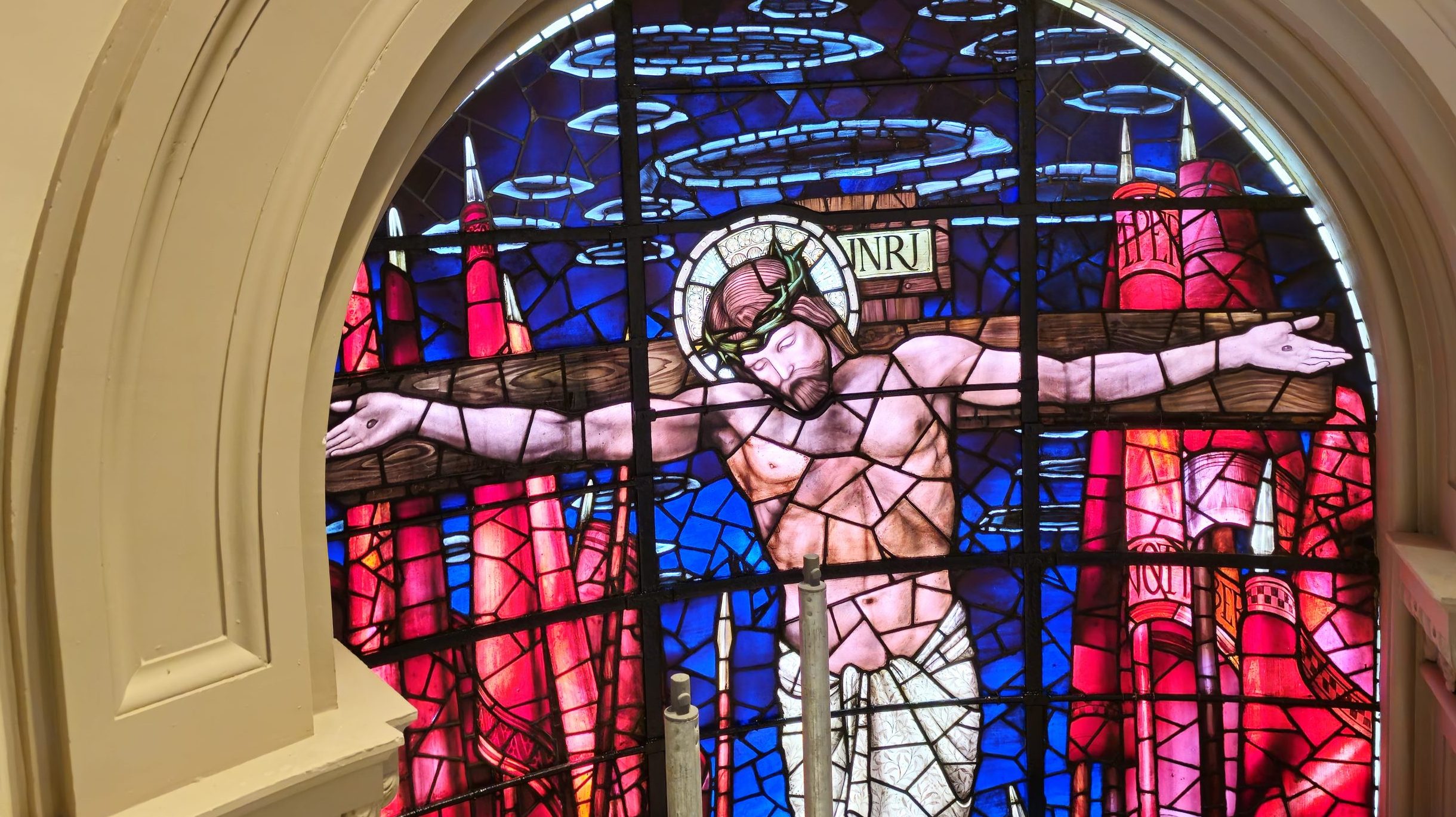
When I was a kid in a multi-faith household, I learned early that the same word can land differently depending on who is speaking. “Prayer,” “salvation,” even “scripture” could mean one thing at my mom’s table and something a little different at my neighbor’s. “Gospel” is like that. It can refer to books, a whole worldview, or a particular vibe of church culture. But in Christianity, at its center, the gospel is an announcement. Not advice. Not a self-improvement program. Not a spiritual ladder you climb. It is good news about what God has done in Jesus, and it calls for a response.

Gospel means “good news”
The English word gospel comes from the Old English gōdspel, often understood as “good news” or “good tidings.” In the New Testament, the Greek word is euangelion, which means “good news,” and in context can also carry the sense of a “message” or “proclamation.” That matters, because the earliest Christian message was not mainly framed as a set of philosophical ideas. It was proclaimed like news: something had happened in history, and it changed everything.
This is why Christians talk about “preaching the gospel.” You do not preach a hobby or a private opinion. You announce news that you believe is true and urgent.
The gospel in 1 Corinthians 15
If you want a compact, widely quoted summary of the gospel in the Bible, many Christians will point you to 1 Corinthians 15:1–5. The apostle Paul reminds the church in Corinth of the message he “delivered” and they “received”:
“Christ died for our sins in accordance with the Scriptures, that he was buried, that he was raised on the third day in accordance with the Scriptures, and that he appeared...”
Notice what is emphasized:
- Jesus Christ is the center of the message.
- His death is not portrayed as a tragic accident, but as a saving act “for our sins.”
- His burial grounds the story in real death, not symbolism.
- His resurrection is the turning point, described as a real raising up, not merely a metaphor for hope.
- His appearances point to public witness, not a private spiritual experience.
That repeated phrase, “in accordance with the Scriptures,” is Paul’s way of saying this was not a random detour in the story of Israel. Christians believe the cross and resurrection fulfill what God had been promising and foreshadowing all along.
In other words, the gospel is not simply “God loves you,” even though Christians would say that is wonderfully true. The gospel is the particular way Christians believe God’s love took shape in history: through Jesus’ life, death, and resurrection.
The gospel in the Gospels
The word gospel also appears throughout the four books Christians call “the Gospels” (Matthew, Mark, Luke, and John). These books are not only biographies. They are written to proclaim and interpret the good news about Jesus.
For example, Mark opens with a headline: “The beginning of the gospel of Jesus Christ...” (Mark 1:1). Soon after, Jesus is described as proclaiming “the gospel of God” (Mark 1:14–15), calling people to repent and believe.
Here the gospel includes the announcement that God’s reign is breaking in through Jesus, and that people are invited to respond. The story then moves steadily toward the cross and resurrection, which the early church came to understand as the climactic “good news” event Paul summarizes in 1 Corinthians 15.

What the gospel is and is not
Because the word “gospel” gets used in so many ways, it can help to gently draw a boundary.
What Christians mean by “the gospel”
- Good news about Jesus: who he is and what he has done.
- His saving death and resurrection: “Christ died for our sins... he was raised.”
- The whole Jesus story: his life, teachings, kingdom announcement, cross, and resurrection, with the cross and resurrection as the center of gravity.
- An invitation and call: to repent, believe, receive, follow, and trust.
What the gospel is not identical to
- A church’s entire body of teaching. Christianity includes many doctrines and ethical teachings, but the gospel is the core announcement that generates the rest.
- General moral instruction. Commands matter in Christian life, but they are not the same as the good news itself.
- A political program. Christians may draw social implications from the gospel, but the gospel is first an announcement about Jesus and reconciliation with God.
- A personal success strategy. The gospel offers deep hope and transformation, but it is not a guarantee of comfort, wealth, or ease.
This difference is especially important because people often come away from Christianity thinking it is mainly “be a better person.” Many Christians would say the gospel begins somewhere else: God has acted first.
Grace at the center
If the gospel is “good news,” what makes it good?
In classic Christian teaching, the answer is grace. Not grace as “good manners,” but grace as undeserved gift. The gospel is good news because it proclaims that God does not wait for humans to fix themselves before moving toward them. Instead, God initiates rescue and reconciliation.
That is why Paul can say “Christ died for our sins.” The assumption underneath is that sin is real, and it fractures our relationship with God, with one another, and even within ourselves. The gospel announces that God has done something about that fracture through Jesus.
Different Christian traditions explain the “how” with different accents, but the pulse is shared: salvation is received as a gift, not something we can manufacture or purchase with spiritual performance. Faith, in this sense, is not heroic optimism. It is the open-handed trust that receives what God offers.
Believing the gospel
In the New Testament, the gospel is not only information to file away. It is news that calls for a response. When Jesus proclaims the good news, he calls people to “repent and believe” (Mark 1:15). When the apostles preach, they call listeners to trust Christ.
In everyday terms, to “believe the gospel” usually includes:
- Trust: relying on Jesus, not just agreeing that he existed.
- Receiving: accepting grace as gift, rather than payment for spiritual performance.
- Turning: repentance as a reorientation of life toward God.
- Joining: becoming part of a community shaped by Jesus’ teachings, practices, and hope.
Faith is often misunderstood as certainty without questions. Many Christians, in practice, experience faith as relationship and reliance, sometimes alongside doubt, grief, or slow growth.
News before teaching
Churches teach many things: prayer, worship, justice, spiritual gifts, sacraments, discipleship, family life, and more. Those teachings matter. But in historic Christianity, they are meant to flow from the gospel, not replace it.
A simple way to put it is:
- The gospel announces what God has done in Christ for us.
- Christian teaching trains us in how to live in light of that gift.
If you reverse that order, Christianity can start to feel like an exhausting project. If you keep the order, many Christians find that ethics and spiritual practices become a response to grace rather than a desperate attempt to earn it.
Common questions
Is the gospel just “Jesus loves you”?
“Jesus loves you” is a beautiful Christian conviction, but the gospel is usually presented more specifically as the good news of Jesus’ death for sins and resurrection, and the invitation to trust him. Love is the heartbeat. The cross and resurrection are the shape that love takes in the Christian story.
Why does the gospel include sin?
Because Christianity takes seriously the idea that something is spiritually broken that we cannot fully repair from the inside. Without that diagnosis, the cross can sound like an overreaction. The gospel announces that Jesus’ death deals with sin and reconciliation, and that forgiveness is offered by grace.
Do Christians have to agree on every doctrine to share the same gospel?
Christians disagree on many secondary matters. Still, across Catholic, Orthodox, and Protestant traditions, you will often hear the shared center: Jesus Christ, crucified and risen, offering forgiveness, reconciliation, and new life, received through faith.
Are the “Gospels” the same thing as “the gospel”?
Related, but not identical. The “Gospels” are four New Testament books that tell the story of Jesus. “The gospel” is the good news those books proclaim, especially focused on Jesus’ saving work in his death and resurrection.
A quiet takeaway
In my garden out back, everything depends on what comes first. Do I demand fruit from a plant that has not been watered, rooted, or nourished? Or do I tend the soil and let fruit be the result?
Christians proclaim the gospel as that first, nourishing reality: God has acted in Jesus. Christ has died for sins, was buried, and has been raised. And because that is the announcement, the invitation follows naturally: receive it, trust it, and step into the life it opens.