I still remember the first time I heard “Jesus Loves Me” outside a sanctuary. It was hummed in a hospital hallway, barely above a whisper, like someone was trying to keep the air calm. Later I learned what many of us never get told as kids: this song did not originate as a hymn written for church use. It began as a line of comfort inside a novel.
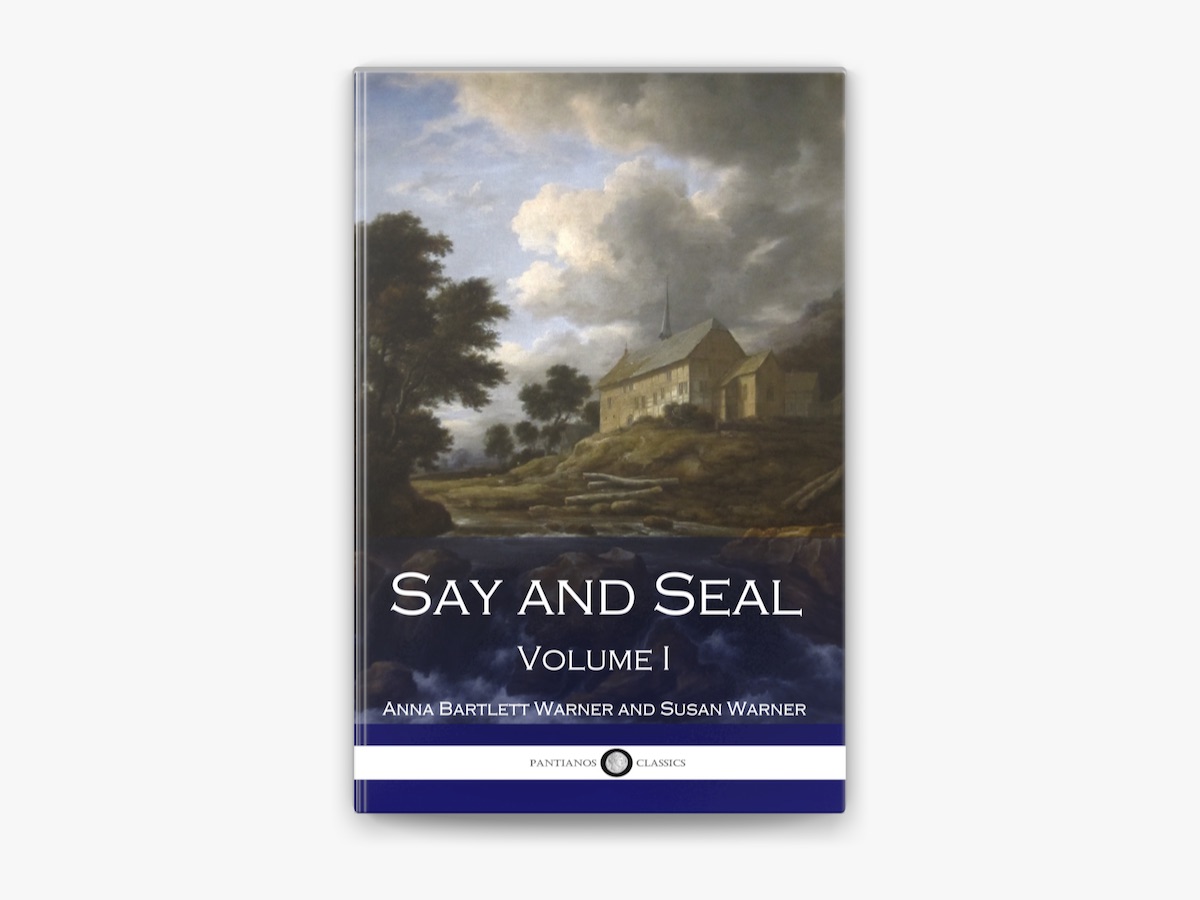
The story behind “Jesus Loves Me” is surprisingly specific. It leads us to the Warner sisters and their 1860 book Say and Seal, and to a composer who, two years later, gave the poem a melody and a refrain that children could easily remember.
Before it was a song
Anna Bartlett Warner (1827 to 1915) wrote the words that would become “Jesus Loves Me.” She and her sister, Susan Warner, were known in their day for popular, faith-tinged novels and devotional writing. Their lives were marked by the kind of practical Christianity that tries to hold steady when money is uncertain and grief is not theoretical.
Biographical sketches often place the Warner sisters on Constitution Island, just across the Hudson River from the United States Military Academy at West Point, where they were associated with the chapel and the community there. Because that detail is repeated so often and so confidently, it is worth treating it carefully. Whatever the precise timeline of where they slept in any given season, the larger point holds: their writing grew out of a Hudson Valley world where everyday life and earnest faith were braided tightly together.
In 1860, the Warner sisters published Say and Seal together. Susan is often credited with most of the prose, while Anna contributed poems woven into the story. One of those poems, written to comfort a child in the novel, is the seed of what we now sing as “Jesus Loves Me.”
That origin helps explain the song’s tone. The language is plain. The message is intimate. It does not argue anyone into belief. It simply repeats love until love feels believable.
The scene in the novel
When people call “Jesus Loves Me” a children’s song, they are not just talking about how it is used today. They are pointing back to its first purpose. In Say and Seal, the poem appears in a sickroom scene, offered as comfort to a seriously ill child.
I am being deliberately modest with details here, because the internet is full of confident summaries that glide past the actual text. What can be said without stretching the record is this: the lyric is framed as bedside reassurance. It is meant to be spoken into fear and weakness, not performed for an audience. It begins where children begin, with the need to know they are not alone.
The best-known opening lines are the ones most of us can say from memory:
Jesus loves me! This I know,
For the Bible tells me so.
Notice what the lyric does. It anchors a feeling, “Jesus loves me,” to a source of authority a child is likely to have already heard about, “the Bible tells me so.” In the novel’s scene, this works like a handrail. When a child’s body or world feels unsteady, the words offer something fixed to hold.
It is also worth noticing what the lyric does not do. It does not describe a dramatic conversion, a historical event, or a personal résumé of suffering. It stays close to the child’s scale: love, belonging, safety, and being held.
Bradbury gave it music
Two years after Say and Seal was published, the poem found a second life through William Batchelder Bradbury (1816 to 1868), a composer, choir leader, and music publisher deeply involved in congregational singing in the mid-19th century.
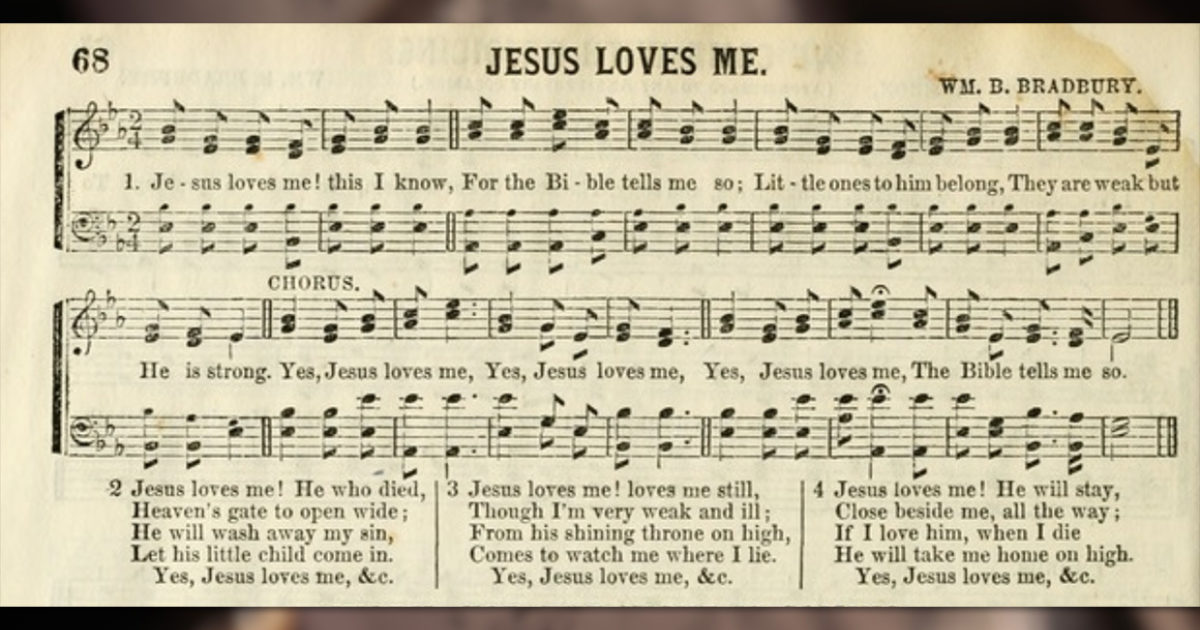
In 1862, Bradbury set Warner’s words to a tune and, crucially, added the refrain that most people recognize instantly. His setting appeared in his Sunday school songbook The Golden Shower (1862), which helped carry the song beyond the novel and into classrooms and church gatherings.
Yes, Jesus loves me!
Yes, Jesus loves me!
Yes, Jesus loves me!
The Bible tells me so.
That chorus is not a decorative add-on. It changes how the piece functions.
- It invites participation. A refrain gives a group something they can join quickly, even if they do not know every verse.
- It matches a child’s learning style. Repetition is how children memorize, and how anxious hearts steady themselves.
- It turns reassurance into communal speech. The “Yes” is a gentle insistence, like a room answering doubt with tenderness rather than force.
Bradbury also did something typical of hymn culture in his era: he published the song where teachers and song leaders could actually use it. Once a piece appears in widely used music collections, it can travel from town to town, church to church, classroom to classroom. A lyric that began as bedside comfort in a novel could now be sung by thousands.
Why children kept it
“Jesus Loves Me” did not become a children’s staple by accident. It fit the spiritual education practices that were growing rapidly in 19th-century American Protestant life, especially in Sunday schools and children’s meetings, where singing was often taught by call-and-response and steady repetition.
Churches needed songs that were:
- Simple enough to learn by ear. Many children learned music by listening and repeating, not by reading notes.
- Short enough to hold attention. The refrain carries the emotional center even if only one verse is remembered.
- Clear in theology. The central claim is direct: Jesus loves the child, and that love is trustworthy.
- Gentle in tone. It teaches doctrine through affection rather than fear.
There is also something psychologically perceptive about the lyric. Children do not usually start with abstract metaphysics. They start with belonging. Am I safe? Am I known? Am I loved? The song answers those questions before a child even knows how to ask them out loud.
Over time, what was once a specific literary moment became a kind of spiritual lullaby across many kinds of churches. Even communities that disagree on plenty of doctrine often agree that a child should begin with love.
What the words stress
Different hymnals have printed slightly different verses over the decades, and some communities sing only a portion. Still, the heart of Warner’s lyric remains recognizable: a small person is cherished by a great love.
One line that has stayed especially resonant is the contrast between weakness and care:
Little ones to Him belong;
They are weak, but He is strong.
In adult ears, the word “weak” can sound uncomfortable, especially in a culture that prizes competence. But in a child’s world, “weak” can simply mean “small.” It can mean, “I cannot carry this by myself.” The song answers not by shaming that smallness, but by locating strength in divine tenderness.
As for variation, most changes are editorial and practical rather than dramatic. Some hymnals omit lesser-known stanzas for space, and some children’s collections favor the most comforting lines. The chorus tends to remain intact, which is part of why the song stays lodged in memory.
From page to memory
Once Bradbury’s setting circulated, “Jesus Loves Me” entered the everyday patterns of church life. It showed up in songbooks, Sunday school materials, and family singing at home. Adults taught it because it was easy. Children kept it because it was comforting. Many people carried it into adulthood because it became associated with the earliest experiences of prayer and belonging.

It also became a song used at thresholds. I have heard it at baptisms and bedtime routines, and yes, in hospital rooms. It is not only for children. It is for the part of any of us that still becomes small when the world feels too big.
FAQ
Who wrote “Jesus Loves Me”?
The lyric was written by Anna Bartlett Warner and first appeared as a poem within the Warner sisters’ 1860 novel Say and Seal.
Who wrote the music?
William B. Bradbury wrote the tune and published his setting in 1862 in The Golden Shower, a Sunday school songbook. He also added the familiar refrain, “Yes, Jesus loves me,” which helped the song spread in group settings.
Was “Jesus Loves Me” first written for church?
Not in the usual sense. The words first appeared inside a work of fiction as bedside comfort for a sick child. Only later was it set to music and adopted broadly in church and classroom singing.
Why do some versions have different verses?
As the hymn circulated through hymnals and children’s collections, editors sometimes selected fewer stanzas to fit space or teaching goals. Most of the variation is what gets included, not a rewrite of the song’s central message.
Closing
Knowing the origin of “Jesus Loves Me” changes how I hear it. I no longer imagine it starting in a grand sanctuary. I picture a quieter scene: a child needing comfort, an adult offering words like a blanket, and later a composer shaping those words into something a whole room could sing together.
Maybe that is why it still works. The song does not ask us to be impressive. It asks us to be honest enough to receive love, the kind that can be spoken simply, sung together, and remembered even when other words fail.