In my childhood home, prayers rose in different accents. Some sounded like a church hymn. Others sounded like quiet meditation. But the questions underneath were often the same: What do we do with the ways we have hurt one another, and with the ache that something is broken between us and God?
In Christianity, the word that gathers those questions into one focused claim is atonement. It is shorthand for what historic, mainstream Christianity believes God has done through Jesus’ death and resurrection to deal with sin and to reconcile human beings to God.

A simple definition of atonement
Atonement in Christianity means that through Jesus Christ, especially his death on the cross and his resurrection, God addresses human sin and restores relationship between God and people.
Christians often describe atonement with a cluster of biblical words:
- Forgiveness of sins
- Reconciliation with God
- Redemption or being “bought back” from bondage
- Justification or being “made right” with God
- Salvation or rescue and healing
Different churches may emphasize different terms, and some traditions draw sharper lines between ideas like atonement, justification, and sanctification. Still, in classic Christian teaching these themes are deeply related, overlapping ways of describing God’s restoring work in Christ.
Why Christians think atonement is needed
Christian Scripture frames the human problem as more than bad habits or occasional moral failure. The Bible uses the word sin to describe a condition that ruptures communion with God and distorts human life.
Sin shows up as personal wrongdoing, yes, but also as a deeper misalignment: hearts turned inward, loves disordered, communities fractured, creation groaning. This is why Christian worship regularly includes confession. It is not meant to be a weekly rehearsal of shame. It is meant to be honest about reality.
Romans 3:23 puts it plainly: “for all have sinned and fall short of the glory of God.” In Christian understanding, atonement answers that falling short with God’s reaching toward us.
Cross and resurrection
When Christians speak of atonement, they are usually pointing to two inseparable events:
- Jesus’ crucifixion, where he suffers and dies.
- Jesus’ resurrection, where God raises him from the dead.
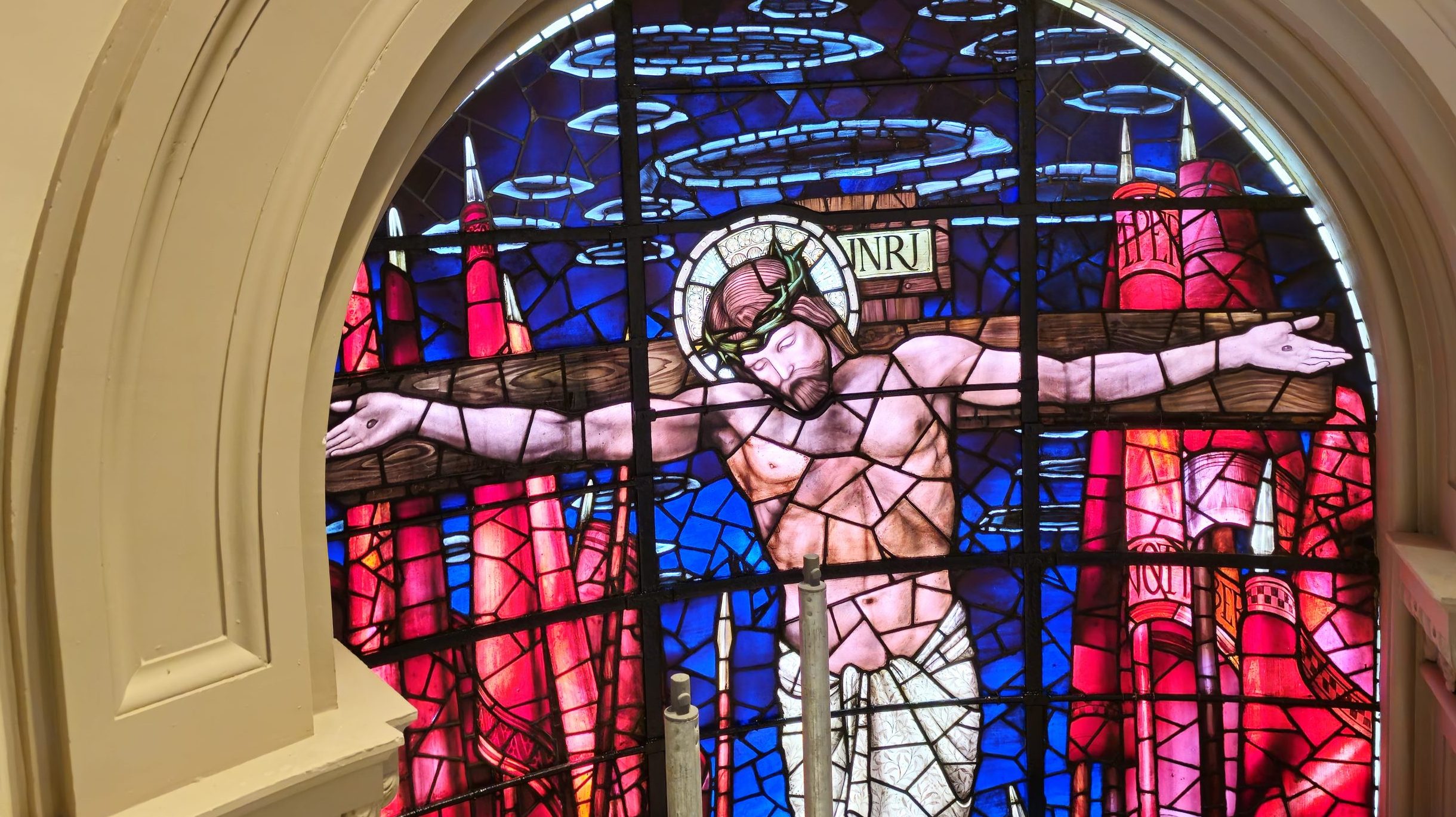
The New Testament treats both as essential. The cross is not only an example of sacrificial love, though it is that. The resurrection is not only comfort after tragedy, though it is that too. Together, they are presented as God’s decisive action against sin and death.
1 Corinthians 15:3-4 offers an early Christian summary: “Christ died for our sins in accordance with the Scriptures, that he was buried, that he was raised on the third day.”
And the story continues. Many Christians also connect atonement to Jesus’ ascension and ongoing intercession, and to the Holy Spirit applying Christ’s work to people in real time, drawing them into union with him and reshaping communities from the inside out.

Key biblical words
If you have ever felt lost in church language, you are not alone. Many of these words are ancient, legal, or temple-shaped. But they are trying to say something tender: God does not leave the wound untreated.
1) Reconciliation
Reconciliation means a repaired relationship. Christianity claims that God moves toward estranged humanity and makes peace possible.
2 Corinthians 5:18-19 says that God “reconciled us to himself through Christ” and that “in Christ God was reconciling the world to himself.”
2) Forgiveness
Forgiveness is not the denial of harm. In the biblical sense, it is the release of guilt and the restoration of fellowship. Jesus speaks of his death in these terms at the Last Supper: “this is my blood of the covenant, which is poured out for many for the forgiveness of sins” (Matthew 26:28).
3) Redemption
Redemption carries the sense of liberation, like being freed from captivity or slavery. In the New Testament, sin and death are not treated as small obstacles. They are powers that human beings cannot simply outgrow. The atonement is described as God’s rescue.
Mark 10:45 says the Son of Man came “to give his life as a ransom for many.”
4) Justification
Justification is courtroom language. It means being declared “in the right.” Many Christians understand the atonement to include God’s verdict of grace over those who trust Christ: not guilty, welcomed, restored.
Romans 5:1 says: “Therefore, since we have been justified by faith, we have peace with God through our Lord Jesus Christ.”
5) Sacrifice and “blood”
Some of the hardest language for modern readers is the Bible’s talk of sacrifice and blood. This language grows out of Israel’s temple worship, where sacrifices symbolized purification, covenant, and the seriousness of sin.
Christians believe Jesus fulfills and completes that story. Hebrews states: “without the shedding of blood there is no forgiveness of sins” (Hebrews 9:22).
Many Christians understand this not as divine cruelty, but as a way of saying that reconciliation is costly, that evil is not a paper cut, and that God provides the remedy rather than demanding that we manufacture it ourselves. And because blood language can be difficult or even triggering for some readers, careful teaching matters, the kind that refuses both denial and sensationalism.
“Jesus died for our sins”
The phrase “Jesus died for our sins” can sound like a slogan, but Christians intend it to be a thick theological statement.
At minimum, most mainstream churches mean something like this:
- Sin is real and it damages relationship with God and neighbor.
- God is holy and does not pretend evil is harmless.
- God is loving and does not abandon sinners.
- In Jesus’ death, God deals with sin in a decisive way.
- In Jesus’ resurrection, God defeats death and opens a new life.
Christians often add that this work is received by faith, not earned by moral performance. That is where atonement and grace meet. Atonement names the work of Christ. Grace names the gift given to us through that work.
In everyday terms, this is meant to change what a believer and a community can live like now: a cleared conscience that can tell the truth, a repaired relationship with God that becomes the seed of repaired relationships with others, and a hope sturdy enough to do justice without despair.
More than individual guilt
Many people first hear atonement framed as personal forgiveness, and that is certainly part of the New Testament’s message. But the biblical story is wider than private spirituality.
Scripture also speaks in cosmic and communal terms: God is reconciling “the world” (2 Corinthians 5:19) and bringing peace to “all things” (Colossians 1:19-20). Christians therefore connect atonement not only with “my sins,” but also with God’s healing of injustice, hostility, and alienation.
In practice, churches vary in how strongly they stress the social and cosmic dimensions. But the raw material is there in the Bible: atonement reaches outward as well as inward.

Love, justice, and mercy
People sometimes assume Christians are choosing between two pictures of God: either God is loving, or God is just. Atonement language tries to hold together what Scripture holds together.
- Love: God acts to save and restore.
- Justice: evil is not waved away as if it does not matter.
- Mercy: the guilty are not treated as beyond hope.
The cross is where Christians see these meeting, not as abstract ideas, but as lived reality. The resurrection is where Christians see God’s “yes” to Jesus and to the new creation he inaugurates.
Common questions
Is atonement the same as salvation?
They are closely related, but not identical. Atonement refers to what Christ has done to reconcile people to God. Salvation is the broader term for being rescued, healed, and brought into new life with God, which Christians believe flows from Christ’s work.
Is atonement only the crucifixion?
Most Christian teaching includes the whole Christ event: Jesus’ life, death, resurrection, and ascension. Still, the cross and resurrection are usually spoken of as the center of atonement because the New Testament repeatedly highlights them as the decisive dealing with sin and death.
Why so many words?
Because sin harms in more than one way. Some metaphors speak to guilt (forgiveness, justification). Others speak to bondage (redemption). Others speak to broken relationship (reconciliation). The variety is not confusion. It is pastoral realism.
Do all Christians explain it the same way?
Historic, Nicene Christianity shares a core confession: in Jesus’ death and resurrection, God makes reconciliation with God possible for sinners. Christians sometimes differ on how to describe the “mechanics” of that reconciliation.
Over the centuries, several major models have helped Christians name what they see in Scripture:
- Christus Victor: Jesus defeats the powers of sin, death, and the devil.
- Satisfaction: Christ restores what human sin has dishonored, offering to God what we could not.
- Penal substitution: Christ bears the judgment sin deserves, so mercy can be given without denying justice.
- Moral influence: the cross reveals God’s love in a way that awakens repentance and transformation.
- Recapitulation: Christ re-lives human life faithfully, healing it from the inside out.
Many churches hold more than one of these side by side, because the Bible itself uses more than one image. What matters most here is the shared center: Christians look to Christ’s work as the place where God tells the truth about sin and opens a real path home.
A gentle way to hold it
When I lead retreats, I often invite people to name what they most long for spiritually: to be clean, to be forgiven, to be free, to be welcomed home, to be made whole.
The Christian doctrine of atonement is an attempt to say that God has answered that longing, not with a self-help program, but with a person. In the Christian story, Jesus does not only teach reconciliation. He is reconciliation, offered to a world that cannot quite stop breaking itself.
If you are exploring, you do not have to force yourself into a single emotional reaction to the cross. Start smaller. Let the claim sit in your hands: that in Christ, God moves toward human beings in love, tells the truth about sin, and opens a real path home.