I grew up in a home where multiple faiths shared the same dinner table. When people argued, it was rarely about whether God existed. It was about what love, forgiveness, and repair are supposed to look like in real life. That is part of why Martin Luther’s 95 Theses still matter to me. Underneath the Latin and the late medieval church politics is a human question that never gets old: when we have done harm, what actually heals the soul?
The 95 Theses were not a complete “Protestant system,” and they were not a neat list of everything Luther would later teach. They were a set of propositions for academic debate, focused on one boiling-point issue in 1517: indulgences and what they were being made to mean for repentance, grace, and the authority of the church.
What the 95 Theses are
The “95 Theses” are ninety-five short statements written by Martin Luther, an Augustinian friar and professor of theology in Wittenberg, a town in Electoral Saxony within the Holy Roman Empire (in what is now Germany). Their original purpose was to invite scholarly discussion. In the academic culture of the time, it was normal to circulate theses for a disputation, basically a structured debate.
They are tightly centered on indulgences, repentance, and pastoral care. Luther’s central anxiety was not abstract. It was spiritual and practical: he believed ordinary Christians were being encouraged, by some popular preaching and sales tactics, to treat a purchased indulgence as a kind of spiritual shortcut, sometimes even as a substitute for real repentance and inner transformation.
So the theses ask, again and again, questions like these:
- What is true repentance?
- What, if anything, can a papal indulgence actually do?
- How should the church speak about forgiveness without turning grace into a transaction?
- What should Christians do with fear, guilt, and the desire for assurance?
Key terms
If the topic feels technical, a few basic definitions help:
- Indulgence: In official late medieval teaching, an indulgence was connected to the remission of temporal punishment for sin, not the forgiveness of guilt itself. It was tied to penance and the church’s ministry, and it was not supposed to function as permission to sin or a substitute for repentance.
- Temporal punishment: The idea that even forgiven sin can carry consequences requiring purification or healing. In the late medieval imagination, this could be connected with penance on earth and purification after death.
- Purgatory: A state of purification after death in medieval Catholic teaching, often understood as connected with the completion of that healing work.
- Contrition: Genuine sorrow for sin, not merely fear of consequences. Luther worries that outward acts can crowd out inner change.
The occasion: indulgence preaching in 1517
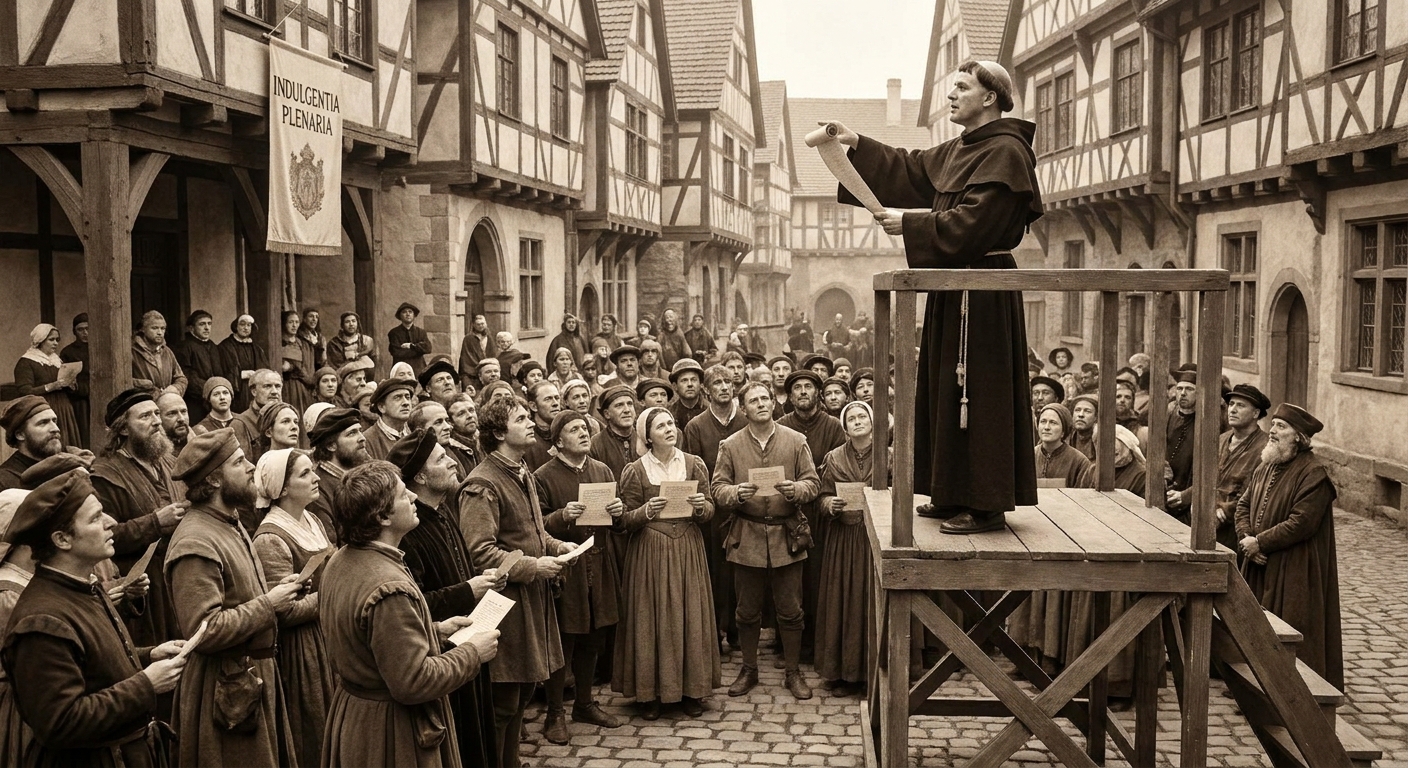
To understand the 95 Theses, you need the immediate context. In Luther’s day, indulgences were often preached in ways that listeners could easily hear as: if you pay, you can reduce punishments connected with sin. Official theology drew lines between guilt and temporal punishment, but in street-level messaging those lines could blur.
That message landed in a Europe where many people were deeply concerned about purgatory, the communion of saints, and the fate of loved ones. Luther, as a pastor and confessor, encountered people who were clinging to a document and a payment as if it were the heart of the gospel.
The theses push back on that. Luther’s target is less “ordinary believers” than the preaching that was forming them, and the financial and spiritual incentives tangled up with that preaching.
Did Luther post them on a door?
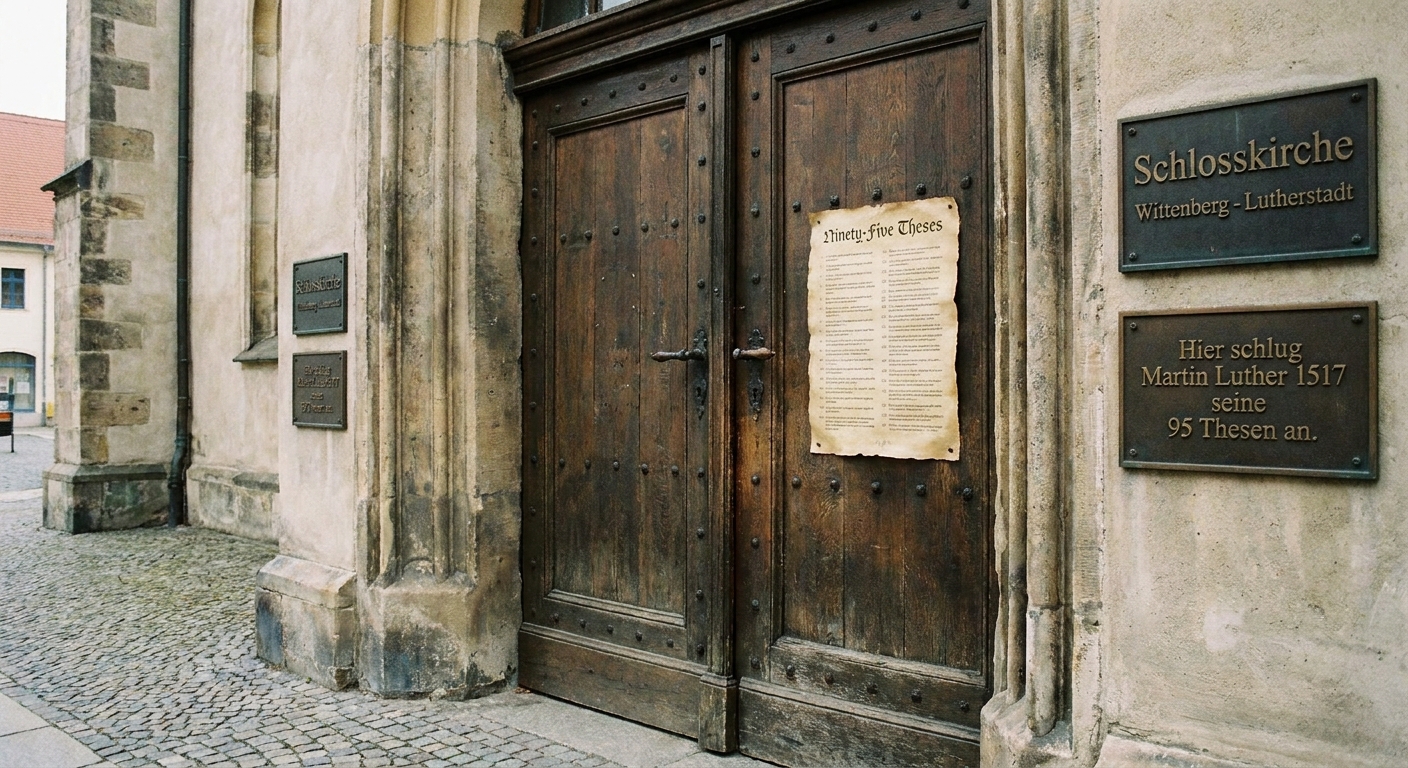
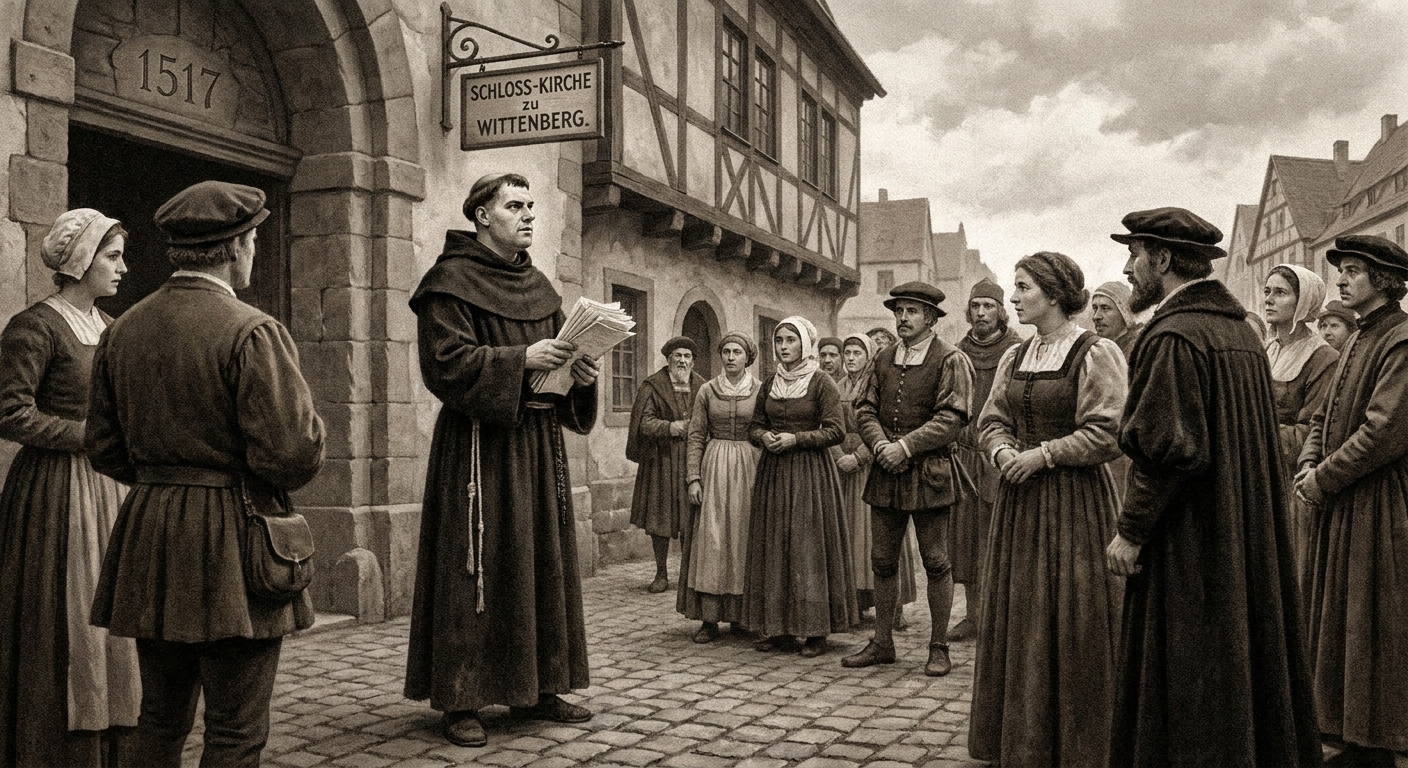
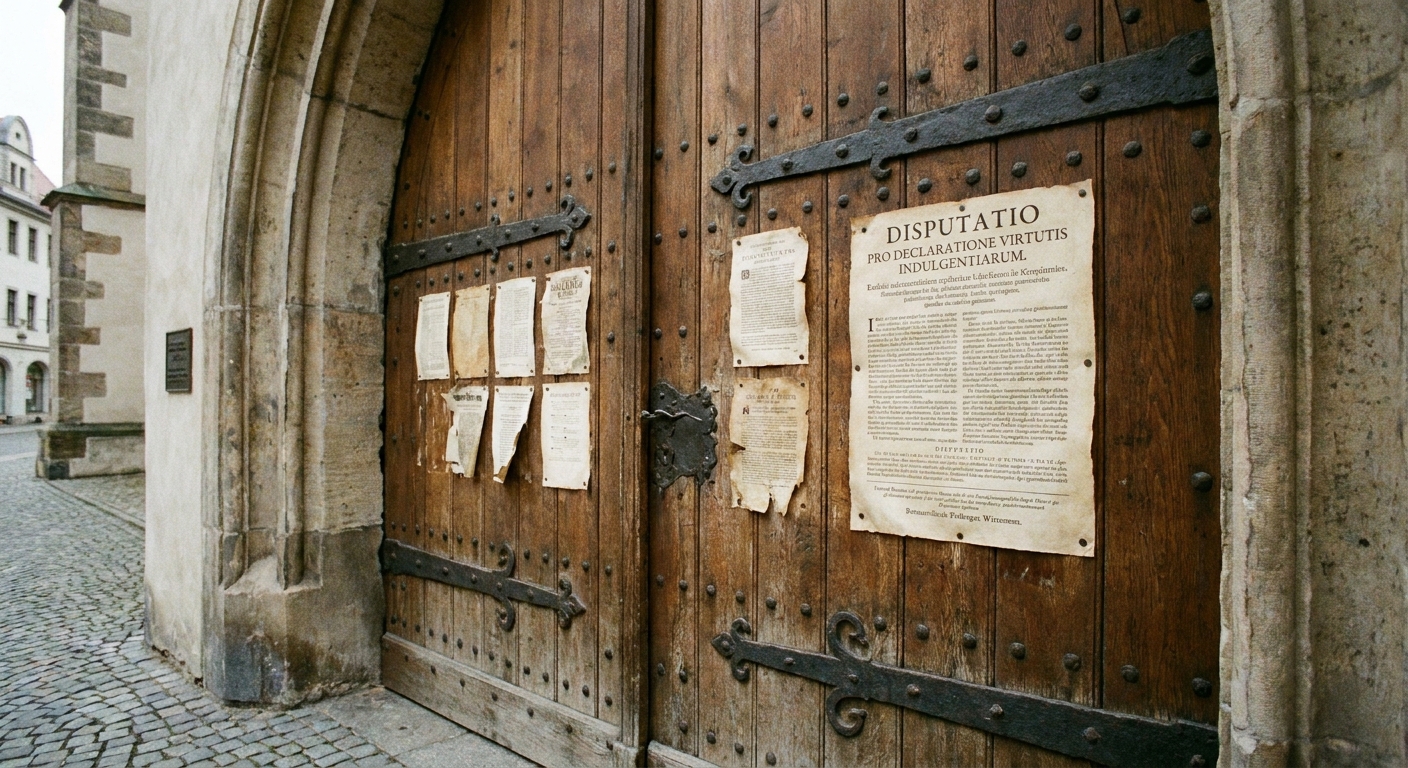
The famous image of Luther nailing a sheet to the Castle Church door in Wittenberg is powerful, and it has become a symbol of protest. Historically, what we can say with confidence is more modest: Luther composed the theses and sought a debate about indulgences. Posting theses on a church door would have been a conventional way to announce a disputation, since church doors sometimes functioned like a community bulletin board.
Whether the physical hammer-and-nail moment happened exactly as later imagination pictures it is debated among historians. But the deeper point holds either way: Luther’s initial posture was that of a professor inviting argument, not a reformer unveiling a finished alternative church.
How the theses spread
Even if Luther intended an academic debate, the theses did not stay inside the university. They were written in Latin, but they quickly moved beyond Latin-reading scholars.
In the early 1500s, printing technology made it possible for ideas to travel with unusual speed. The theses were copied, translated into German, printed, and circulated widely. What began as a disputation text became public controversy, because the subject was not just theological. It touched money, authority, and the spiritual anxieties of everyday people.
One reason they spread so quickly is that many readers recognized the pastoral problem Luther was naming. Another reason is that criticism of indulgence abuses already existed in various forms, so the theses landed on dry tinder.
What Luther argued
The theses are best read as a sustained attempt to protect repentance and grace from being reduced to a market exchange. Luther makes several intertwined arguments, some sharper than others, and some framed as questions rather than final declarations. It also helps to look at a few specific theses, because Luther often makes his point in brief, pointed lines.
1) Repentance is whole-life
At the heart of the theses is a call to take repentance seriously. Luther insists that repentance is not merely an external act or a box to check. It is a real, inward turning of the person toward God, and it shapes the whole life.
That is why Thesis 1 is so often quoted: when Jesus says “Repent,” Luther argues, he wills “the entire life of believers” to be repentance. Luther is pushing against any approach that lets a person outsource the hard work of moral and spiritual repair to a document, a payment, or a ritual performed without the heart.
2) Indulgences are limited
Luther does not start by denying that indulgences exist or that the pope has any authority. Instead, he presses on limits and clarity. If indulgences have any legitimate role, he argues, they should not be preached as though they forgive guilt, erase sin itself, or replace genuine penitence.
In other words, he challenges the inflated claims people were hearing at street level, not only the careful distinctions trained theologians might make in a classroom.
3) The pope is not a blank check
The theses include statements that sound cautious, even protective, of the pope. Luther sometimes frames the problem as reckless indulgence sellers making claims the pope would not approve. But he also raises uncomfortable questions about what papal authority can actually do when it comes to souls and punishments.
He asks, in effect: if the pope truly has the power to remit penalties, why would he not do so freely out of love rather than in connection with fundraising? This is not just a doctrinal puzzle. It is a moral question about what the church looks like to the poor, the grieving, and the anxious.
4) What he opposed in practice
Some indulgence campaigns were criticized for sounding like spiritual math. A line later associated with indulgence preaching was, “As soon as the coin in the coffer rings, the soul from purgatory springs.” Luther targets that kind of sales logic directly. In Theses 27 and 28, he argues that claims like these cultivate false confidence and confuse human transactions with God’s mercy.
He also insists that the true treasure of the church is not a storehouse of merits managed like an account. Thesis 62 famously puts it plainly: the true treasure of the church is “the most holy gospel of the glory and grace of God.”
What the theses did not do
It is easy, looking backward, to treat the 95 Theses as if they were the opening chapter of a complete Protestant theology. They were not.
- They were not a full break from the Catholic Church. In 1517, Luther is still thinking and speaking within the church’s structures, even as he strains against them.
- They were not a manifesto. Many theses are deliberately phrased as debate points, not final conclusions.
- They were not a tidy summary of later Reformation slogans. Later catchphrases that summarize Protestant convictions came afterward, shaped by years of conflict, study, and institutional separation.
Reading the 95 Theses accurately means letting them be what they are: a focused dispute over indulgences and the pastoral meaning of repentance and forgiveness.
What happened next
The theses did not end the indulgence controversy. They widened it.
In 1518, Luther defended and developed his thinking in contexts like the Heidelberg Disputation, and his conflict with church authorities escalated. Over the next few years, arguments about indulgences expanded into larger disputes about authority, Scripture, and the nature of grace. By 1521, after a series of confrontations and condemnations, Luther was excommunicated and summoned to the Diet of Worms, where he refused to recant unless convinced by Scripture and clear reason. The debate Luther hoped to stage inside the academy became a rupture that reshaped Europe.
Why they still matter
Even though the theses are narrowly focused, the nerve they touched ran deep. They raised questions about authority, conscience, and what salvation language does to ordinary people.
When a religious system is experienced as transactional, people tend to swing between two pains:
- Scrupulosity: constant fear of not having done enough.
- Shortcut spirituality: the belief that a single action can bypass inner change.
Luther’s theses confront both. They insist that grace is not for sale and that repentance is not performative. That spiritual intuition, whatever one’s tradition, remains strikingly modern.
Reading tip
If you ever read the theses themselves, try reading them as pastoral triage rather than as a doctrinal blueprint. Imagine a priest listening to anxious parishioners, watching them pin their hope on a piece of paper, and then trying to bring the conversation back to the inner life: contrition, mercy, and the long work of becoming whole.
I come back to that because it echoes the dinner-table arguments of my childhood. The details change across centuries, but the question stays stubbornly personal: when we want forgiveness, are we looking for transformation or a receipt?
You do not have to be Lutheran, Protestant, or even Christian to recognize the core warning: when the human hunger for forgiveness meets a system that can monetize reassurance, the soul is at risk of being managed rather than healed.
FAQ
What were the 95 Theses about?
They were written primarily about indulgences and the way indulgences were being preached and understood. Luther argues for genuine repentance and challenges claims that indulgences can replace inner conversion or automatically free souls from punishment.
Were the 95 Theses in German?
No. Luther wrote them in Latin for academic debate, but they were quickly translated into German and printed, which helped them spread widely.
Did Luther mean to start the Reformation?
The theses read more like an invitation to disputation than a revolution plan. Luther is still working within the church’s intellectual world in 1517. The larger break came later through a chain of responses, condemnations, and escalating theological disputes.
What is the “treasury of merits”?
It is a medieval concept connected to the merits of Christ and the saints, often described as a spiritual treasury from which the church could draw in granting indulgences. Luther questions how this idea was being presented to ordinary people and insists the true treasure of the church is the gospel itself.
Are the 95 Theses the same as later Protestant slogans?
No. The 95 Theses are a 1517 set of debate points about indulgences and repentance. Later Protestant summary slogans came afterward and reflect later developments in theology and conflict.